Krav Maga is built for the moments you do not get to rehearse, so your safety plan is simple, fast, and realistic.
Most people do not start training because they want to “fight.” You start because you want options. In Lindale, that can mean walking to your car after dinner, answering the door at a weird hour, or commuting near I-20 and dealing with drivers who have forgotten how to be normal.
That is why we teach krav maga the way it was intended: practical, direct, and focused on getting you home. Our training emphasizes simple movements, aggressive counterattacks, and targeting vulnerable areas so you can create an escape window, even when you are smaller or caught off guard.
You will also get in shape without needing a separate workout plan. A typical hour of training can burn around 616 calories on average, which puts it firmly in the moderate-to-vigorous category. You are not just learning self-defense, you are building cardio, strength, and confidence at the same time.
Why our krav maga training works under real stress
In real life, you do not get perfect timing, perfect distance, or a respectful opponent. You get adrenaline, confusion, and a short time to decide. Our krav maga approach is designed around that reality, and it is one reason military and police organizations worldwide rely on this system for fast, practical progression.
We train for common attacks, not choreographed ones
We spend time on the messy stuff: grabs, tackles, chokes, surprise punches, and threats that start at conversational distance. We also practice getting up off the ground quickly, because falling down in a parking lot is not the same as a padded mat in a quiet room.
We focus on “escape first,” not winning points
Our goal is not to prove toughness. Our goal is to help you break contact and leave. That usually means striking decisively, moving with purpose, and using your surroundings.
We build the mindset that keeps techniques usable
Krav maga is physical, but the mental side matters just as much. We run realistic drills so your body learns what “stress” feels like in a controlled setting. Over time, that helps you make better decisions faster, instead of freezing or trying to negotiate with someone who is already committed to hurting you.
Situation 1: Street muggings, wrist grabs, and sudden chokes
A lot of real-world violence starts with control. Someone grabs your wrist to steer you, clamps a hand around your neck, or crowds your space to intimidate you. Those are not “fight stances,” they are ambushes, and they happen fast.
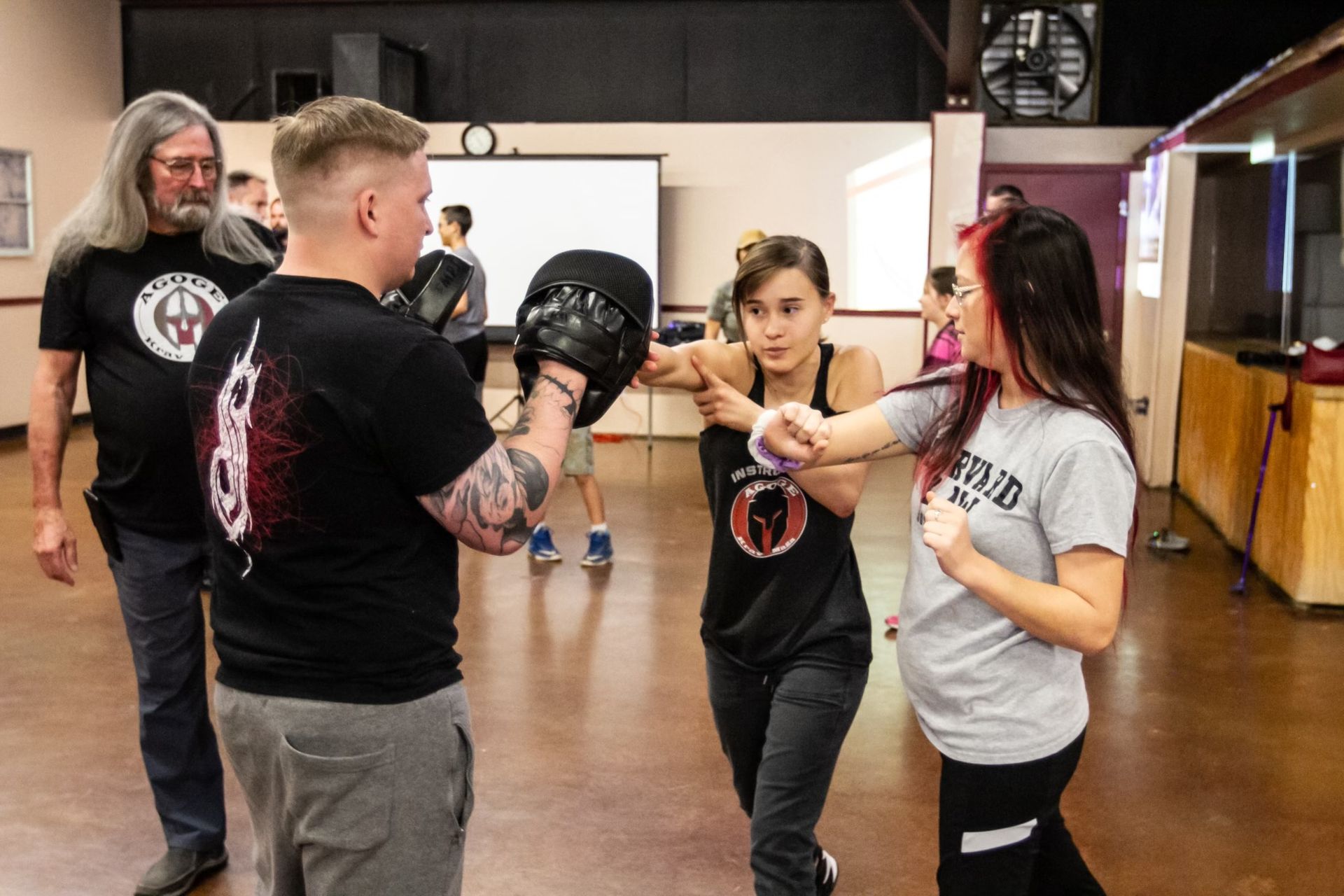
In our krav maga classes, we work defenses against common grabs and chokes with a simple idea in mind: you need an immediate response that disrupts the attacker’s control. That can involve plucking a choking hand, driving forward with an aggressive counterstrike, and then creating distance so you can leave.
We also train you to notice the setup. If you see the hands, the shoulders, and the angle of approach early enough, you can often avoid the worst part of the problem. Even a half-step back, a fence with your hands, or turning your body slightly can buy you time.
What we want you to remember in a grab scenario
• Your first job is to protect your airway and posture so you can breathe and move.
• Your second job is to counterattack immediately, because hesitation keeps you trapped.
• Your third job is to escape, not to stay and “finish” anything.
And yes, we address edged-weapon threats too. Knife situations are dangerous and unpredictable, so we train you to prioritize survival: movement, control when possible, and getting away the moment you have a window.
Situation 2: Home invasions and protecting your family
Home is supposed to feel safe, which is exactly why a break-in can be so disorienting. If you have kids, a spouse, or even just a dog that will not stop barking, your brain is trying to process a lot at once.
Our krav maga training emphasizes quick decision-making under pressure. We teach you how to move through tight spaces, how to use angles in hallways, and how to create barriers and exits. We also talk through what “protecting your family” actually looks like, because it is not always charging into a dark room. Sometimes it is getting everyone behind a locked door and calling for help. Sometimes it is guiding someone out through a safer exit. Sometimes it is confronting a threat because you cannot disengage.
We also train awareness and verbal boundaries, because many situations escalate after small warnings are ignored. You can be a kind person and still be firm. That combination matters more than people think.
Situation 3: Multiple attackers and getting surrounded
One attacker is scary. Two or three is a different problem entirely, and it changes what “good technique” looks like. In multiple-attacker situations, staying in one place is usually a mistake. You want mobility, you want to avoid being flanked, and you want a path out.
We train you to move so you are not boxed in. That can mean circling to keep one person between you and the others, striking hard enough to create space, and using quick scans so you do not get surprised from the side.
This is where krav maga really shows its personality. It is not delicate. It is not complicated. It is direct. When you are outnumbered, simple tools that work under stress are the tools you want.
A practical rule we coach often
Do not try to “handle” everyone. Create a gap and leave. If you cannot leave, you fight for the gap again. That is the loop.
Situation 4: Random public assaults, road rage spillover, and parking lot violence
In a small community near a busier hub like Tyler, you get a mix of quiet routines and sudden friction. Parking lots, convenience stores, events, and highway exits are common places for problems because people are distracted, carrying bags, or focused on getting in and out quickly.
Public assaults often look like:
• A sudden shove that becomes a punch
• A bear hug from behind
• Someone trying to drag you or block your path
• A tackle that dumps you onto the ground
Our krav maga classes Lindale students attend are built around these exact patterns. We drill the basics that hold up when you are startled: protecting your head, striking with palms or elbows, using knees at close range, and getting your feet under you if you hit the ground.
We also build “boundary behavior” into training. That means learning to keep your hands up in a non-threatening way, managing distance, and using your voice to discourage someone before they commit. It feels a little awkward at first, then it becomes normal, and honestly, that is a good thing.
Situation 5: Workplace threats and carjacking attempts
Workplace conflict is not always dramatic, but it can turn serious when emotions run hot or someone feels cornered. The same is true in and around your vehicle. A carjacking attempt or an aggressive confrontation at your door is close-range, fast, and usually happens when your hands are busy.
Our krav maga training in Lindale includes scenario work that reflects those realities. We practice from disadvantage positions: seated, backed against a wall, pinned in a corner, or holding everyday items. We also talk about environmental tools, because in real life you might have keys, a bag, a water bottle, or whatever is on your desk.
The real benefit here is not turning you into someone who looks for problems. It is turning you into someone who knows what to do when the problem shows up anyway.
What you will learn in training that carries across every situation
Different scenarios share the same foundation. Once you build that foundation, your response becomes quicker and more consistent. Here are the skills we reinforce again and again:
• Situational awareness that helps you spot danger sooner and avoid it when possible
• Simple, high-percentage strikes that target vulnerable areas to stop aggression fast
• Clinch and close-range tools for when there is no space to “box”
• Escapes from grabs and chokes that prioritize breathing and posture
• Stress drills that teach you to act while your heart rate is high
This is also why so many people report that confidence is the biggest benefit. You start standing differently. You make decisions faster. You stop second-guessing your instincts so much. That shift shows up at work, at home, and anywhere you want to feel more grounded.
Safety, intensity, and how we help you train smart
Krav maga is intense, and we do not pretend otherwise. That intensity is part of what makes it effective, and it is also why smart training matters. Injury risks in combat sports and self-defense training often include sprains, fractures, and lower-limb issues, especially when people push too hard too fast or get sloppy with partner work.
We keep training challenging, but we also coach control, technique, and progression. You will warm up properly, build strength and flexibility over time, and learn how to work with partners without turning every round into a contest. If you are brand new, that structure is what helps you improve quickly without feeling wrecked every week.
Take the Next Step with Agoge Krav Maga
Real safety is not about memorizing a hundred moves. It is about practicing the right responses until they feel natural, even when your heart rate spikes and your brain is racing. That is exactly what we build through consistent krav maga training, and it is why so many Lindale students stick with it once they feel the difference.
At Agoge Krav Maga, we keep the focus on real-world situations, steady progress, and a training environment where you can work hard and still train responsibly. If you are ready to feel more capable in the five situations we covered, we would like to help you start.
Take what you learned here and put it into practice by signing up for a free Krav Maga trial class at Agoge Krav Maga today.