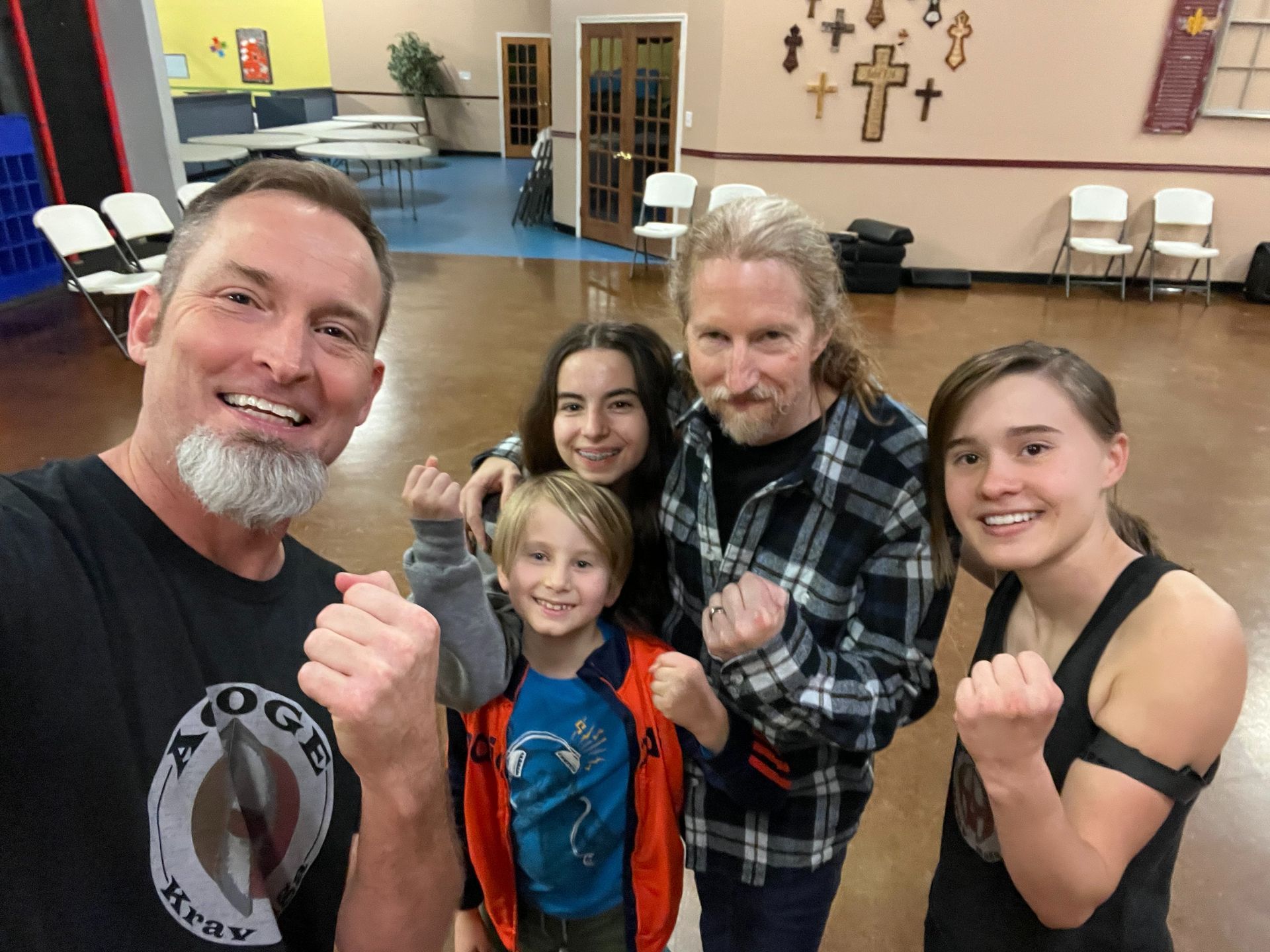
When your family learns the same practical skills together, trust and teamwork stop being ideas and start becoming habits.
Families in Lindale are busy, and finding something that genuinely works for everyone can feel like a minor miracle. You want an activity that builds confidence, burns energy, and teaches real-life skills, but also something that fits different ages, personalities, and fitness levels. That is exactly why our krav maga classes resonate with so many households here.
Krav Maga is practical by design. Instead of collecting complicated moves you never pressure-test, we focus on simple, high-percentage fundamentals, trained through full-body workouts and scenario-based drills that translate to everyday life. And when you train as a family, those benefits multiply. You get shared progress, shared language, and shared wins that show up at home in subtle ways.
In Lindale, where community and family values run deep, training together just makes sense. It is not about turning your home into a boot camp. It is about giving your family a structured way to get stronger, more aware, and more connected, one class at a time.
Why family bonding happens faster in krav maga classes
Family bonding is easier when everyone is on the same team, facing the same challenge. Our training creates that naturally. You are sweating through the same warmups, learning the same base movements, and helping each other remember what to do under pressure. That shared effort does something regular outings often cannot.
A big reason is the way Krav Maga blends physical and mental work. You are not just exercising. You are solving problems while tired, adjusting on the fly, and learning how to stay calm while your heart rate is up. Doing that next to your child, or next to your parent, builds a kind of respect that is hard to manufacture with a normal fitness routine.
It also gives families a shared vocabulary. When we coach concepts like distance management, awareness, and decisiveness, you start using those ideas outside the facility too. Parents notice kids standing a little taller. Kids notice parents taking training seriously. It becomes a loop of encouragement that feels real, not forced.
What to expect in our krav maga classes in Lindale
People sometimes picture martial arts as either super intense or super ceremonial. Our approach is much more grounded. A typical class is a full-body training session built around skills you can actually use, scaled to your current ability.
We usually combine cardio and strength with technique work, then add context through controlled drills. You learn to move with balance, generate power safely, and respond to common problems like grabs, pushes, and close-range strikes. The pace can be challenging, but we coach smart effort, not reckless effort.
In krav maga classes Lindale families attend together, we pay close attention to safety, spacing, and progressions. If you are new, we dial it in so you can learn clean mechanics first. If you are more experienced, we give you layers and variables so you keep growing.
The fitness piece: a shared workout that actually feels useful
A family workout is only fun if it does not turn into someone being left behind. Krav Maga is ideal here because intensity is adjustable without making the training feel watered down. You can go lighter on power, reduce range of motion, or work at a steadier pace and still train the same skill.
Our sessions are full-body by nature: strikes, footwork, agility drills, and conditioning that improves endurance and coordination. You will feel it in your legs, shoulders, and core, but also in your posture and energy. Over time, families tell us they notice everyday benefits like better sleep and more stamina for normal life.
There is also a practical satisfaction to it. Burpees are fine, but learning how to move, protect your space, and stay balanced under stress hits different. When your family sees the “why” behind the workout, motivation tends to stick.
Confidence is the benefit families notice first
Fitness is a big draw, but confidence is often what changes things at home. Recent participation surveys in martial arts point to self-confidence as the top reported benefit, even above getting in shape. That matches what we see on the mat: people start carrying themselves differently when they train consistently.
Kids benefit in a specific way. They learn how to listen, respond, and keep trying when something is awkward at first. That is a real skill. Adults benefit too, especially parents who want to feel more capable and less rattled in stressful moments.
And because families train together, confidence becomes contagious. When your child watches you struggle a little, learn, and improve, it models resilience. When you see your child take coaching and apply it, it builds trust. Those moments are small, but they add up fast.
How shared training strengthens communication at home
A lot of bonding is just communication with less friction. Training helps because it creates structured practice in giving and receiving feedback. In partner drills, you have to be clear, calm, and respectful. You also have to pay attention, because spacing and timing matter.
Parents often tell us they appreciate having something to talk about that is not school stress or screen time. Kids appreciate being taken seriously in a skill-based environment. The dynamic shifts from “parent telling” to “family learning,” which is a big deal.
Krav Maga also teaches boundaries in a concrete way. Concepts like personal space and verbal assertiveness are built into training. Families find it easier to discuss safety, awareness, and decision-making because you are not talking in vague terms. You are referencing what you practice.
A simple progression that works for busy schedules
One reason krav maga in Lindale fits family life is the clarity of the path. You do not need to train every day to make progress. Consistency beats intensity, especially for households juggling school, work, and everything else.
For most beginners, we recommend aiming for 2 to 3 sessions per week. That rhythm builds skill, improves conditioning, and keeps the learning fresh without burning you out. If a busy week happens, you do not “fall behind.” You just pick up where you left off.
Many students feel solid with core basics within 6 to 12 months, assuming steady attendance and coachability. That timeline matters for families because it gives you something realistic to commit to, not a forever promise with no milestones.
What family-friendly training looks like in real life
Training side-by-side does not mean every family member does the exact same thing every minute. It means we create opportunities where parents and kids can share parts of the session, learn compatible skills, and support each other’s growth while still keeping coaching age-appropriate.
Sometimes that looks like a parent and teen drilling the same fundamental strike mechanics with different intensity. Sometimes it is a family working awareness and movement together. Sometimes it is simply warming up together, laughing a little, and then splitting into groups for specific coaching.
The bonding comes from proximity and shared effort, not from forcing everyone into one mold. Our job is to coach the room so every person feels challenged, safe, and included.
The community effect: your family is not doing this alone
Families stay consistent when the environment is welcoming. That is not fluff. Industry retention data shows studios offering family plans retain significantly more members, and it is easy to understand why. When a household commits together, accountability becomes natural.
In our space, you will see encouragement across age groups. People remember what it felt like to be new, and that shared humility is part of the culture. You are not walking into a room where everyone expects you to already know what you are doing.
That community support matters for kids especially. It gives them a place to grow away from screens and social pressure, with clear rules, clear goals, and positive reinforcement that is earned through effort.
Why Krav Maga fits East Texas values
Lindale is a family-oriented East Texas community, and the values here are pretty straightforward: take care of your people, work hard, and be ready when life gets unpredictable. Krav Maga lines up with that mindset because it is built around protecting yourself and your loved ones using practical decisions and direct techniques.
We train for realistic situations, but we also train judgment. Awareness, avoidance, and de-escalation matter. Physical skills matter too, of course, but the bigger goal is being harder to victimize and quicker to respond intelligently.
For families, that becomes a shared mission. You are not just signing up for an activity. You are choosing a standard: we pay attention, we practice, and we show up for each other.
Key ways krav maga classes support family bonding
Here are a few specific ways families tend to bond through training, beyond the obvious “we did a workout together” part:
• Shared challenge builds mutual respect, because everyone experiences discomfort, learning curves, and progress in real time
• Partner drills create healthy communication habits, including clear feedback, patience, and teamwork under mild stress
• Confidence gains change family dynamics at home, with kids and adults showing more calm, focus, and follow-through
• Practical self-defense creates shared purpose, because the skills connect to protecting yourself and the people you love
• Community structure reinforces consistency, giving your family a routine that competes well with screens and scattered schedules
How to start as a family without overthinking it
Getting started is simpler than most people expect. You do not need to “get in shape first,” and you do not need gear beyond basic training clothes. What helps most is arriving with a learner mindset and a willingness to be coached.
A practical way to approach your first month is to focus on attendance and fundamentals. Let your body adapt. Let the basics sink in. Families do best when the goal is consistency, not perfection.
If you want a straightforward plan, follow this progression:
1. Pick 2 to 3 weekly sessions that fit your household routine and protect them like appointments
2. Focus on clean basics first, including stance, movement, and simple striking mechanics
3. Encourage each other on effort, not outcomes, since confidence builds fastest through reps
4. Ask questions after class so we can tailor coaching to your family’s goals and comfort level
5. Revisit progress every 4 to 6 weeks and adjust training frequency as schedules change
Take the Next Step
Family bonding is not just about spending time together. It is about building something together, especially something that improves how you handle stress, communicate, and show up for each other. That is what we aim for in every session, and it is why so many local families choose to make training a shared routine.
At Agoge Krav Maga, we keep our program practical, scalable, and welcoming so you can train side-by-side while still getting coaching that fits each family member. If you are looking for krav maga classes that strengthen both skills and relationships, we would love to help you get started.
Curious about Krav Maga training? A free trial class is the best way to begin.